

Dubai Realty Slows Amid Geopolitical Shocks; India Emerges as Preferred Investment Destination
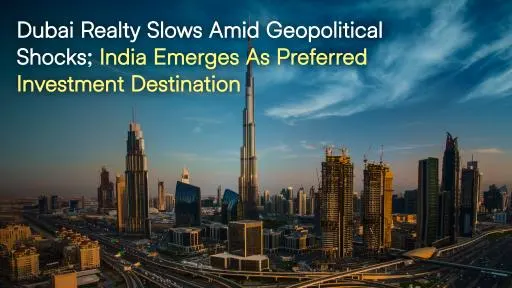
Global real estate markets are undergoing a noticeable shift as geopolitical tensions reshape investor sentiment. Recent developments indicate that while Dubai has long been a favored destination for international property investments, uncertainty in West Asia is beginning to impact its momentum. At the same time, India is gaining strong traction as a preferred real estate investment destination.
Why Is Dubai Realty Slowing Down in 2026?
Dubai’s property market has historically thrived on global investor confidence, luxury appeal, and high rental yields. However, ongoing geopolitical tensions in the Middle East have introduced a layer of uncertainty that is influencing buyer behavior.
Experts suggest that investors are now adopting a cautious approach, delaying decisions or renegotiating deals. This “wait-and-watch” sentiment has led to slower transaction activity, even though the fundamentals of Dubai’s market remain relatively strong.
Additionally, high-net-worth individuals—especially from countries like India—are reconsidering overseas investments due to regional instability. This shift is not necessarily a collapse but rather a temporary slowdown driven by sentiment and risk perception.
Changing Investment Strategies: From Aggressive to Tactical
Another major trend emerging in 2026 is the transformation of investment strategies. Investors are no longer viewing Dubai as a long-term core investment in the same way they once did.
Instead, Dubai is increasingly being seen as a tactical, yield-driven market—where investors enter for short-term rental returns or price opportunities rather than long-term capital appreciation.
This shift reflects a broader global strategy where investors are prioritizing stability and diversification over aggressive expansion into volatile regions.
Why India Is Emerging as a Preferred Investment Destination
As Dubai experiences a slowdown, India is stepping into the spotlight as a stable and promising real estate market. Several factors are contributing to this shift:
1. Strong Economic Outlook
India’s consistent economic growth and expanding middle class are creating sustained demand across residential and commercial real estate sectors. This makes it an attractive long-term investment hub.
2. Lower Geopolitical Risk
Compared to regions affected by ongoing conflicts, India offers relatively lower exposure to geopolitical volatility. This stability is becoming a key decision-making factor for global investors.
3. Rising Domestic Demand
Urbanization, infrastructure expansion, and increased housing demand are driving growth in cities like Gurugram, Mumbai, and Bengaluru. These markets are attracting both domestic and international capital.
4. Shift in NRI Investment Trends
Many Non-Resident Indians (NRIs) are now redirecting funds back to India instead of investing abroad. This reversal is further strengthening the domestic real estate sector.
Global Capital Is Rebalancing
The broader trend indicates that global real estate investment is entering a phase of rebalancing. Investors are diversifying portfolios to reduce risk exposure and focus on markets with stable growth potential.
India is increasingly being viewed as a core, long-term investment destination, while markets like Dubai are becoming more opportunistic in nature.
Echoing this trend, Mr. Pushpender Singh, Founder & Managing Director at JMS Group, pointed to a sharp drop in activity in Dubai. “According to a recent report by Goldman Sachs, following the escalating regional tensions earlier this month, in UAE we’ve seen a 51% month on month drop in transactional volumes,” he said, calling it a “wait and watch” phase among global investors. He added that the luxury segment has been particularly vulnerable, with international buyers reassessing their exposure to regional risks.
What This Means for Investors in 2026
For investors, this shift presents both challenges and opportunities:
- Short-term opportunities may still exist in Dubai, especially in discounted or high-yield assets.
- Long-term wealth creation, however, is increasingly being associated with Indian real estate markets.
- Diversification across geographies is becoming essential to balance risk and returns.
Conclusion
The slowdown in Dubai’s real estate market is a reflection of global uncertainty rather than structural weakness. Meanwhile, India’s rise as a preferred investment destination highlights the importance of stability, growth potential, and domestic demand.
As global conditions continue to evolve, smart investors are likely to prioritize markets that offer resilience and long-term value—and in 2026, India is clearly emerging as one of those markets.